Rate limits and capacity
Distribute load across allowed resources; at limits, wait, switch or return an explicit error according to policy.
Within your allowed model set, choose paths using task needs, quality thresholds and runtime conditions to match model capability with business requirements.
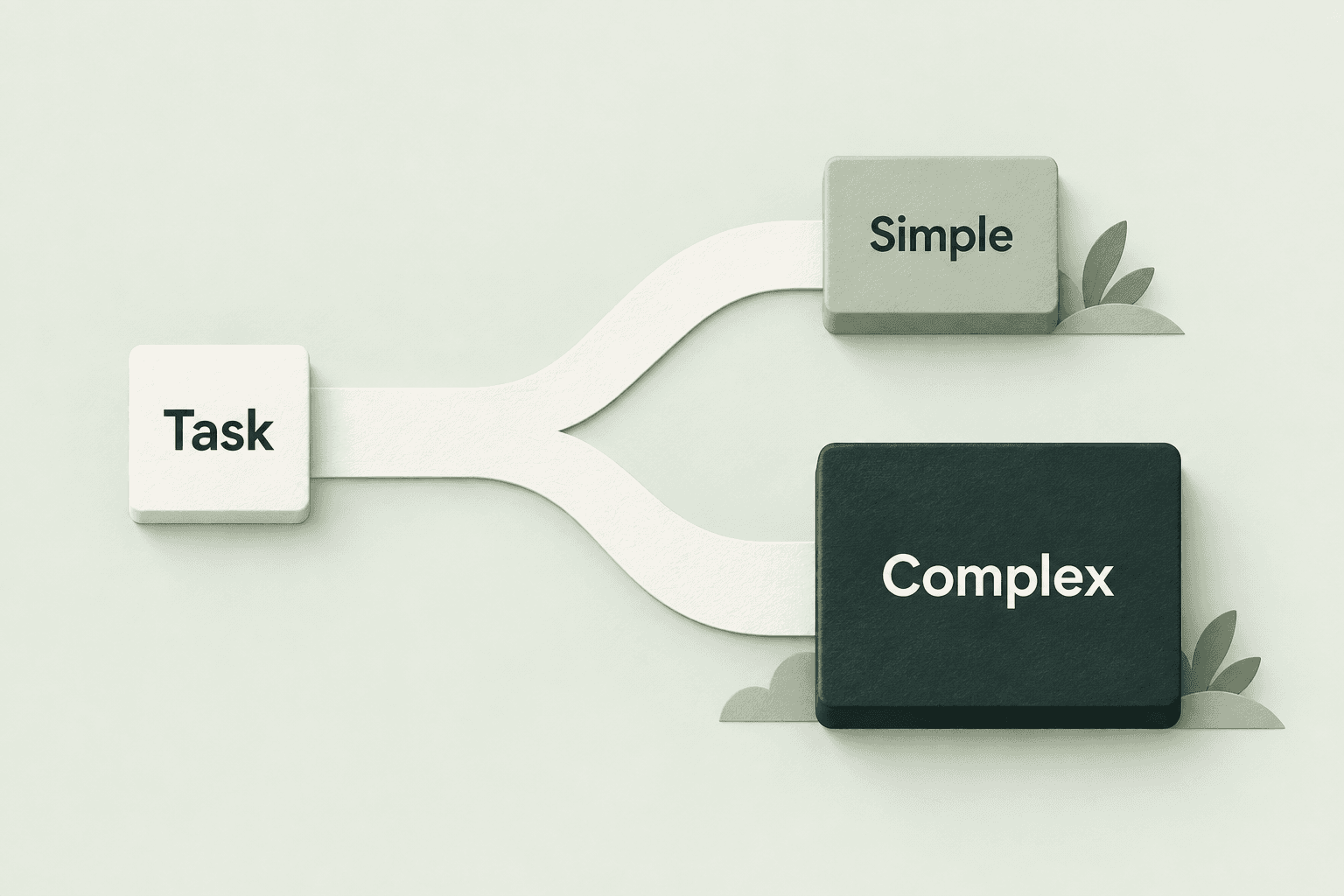
Use lightweight models for extraction and classification, and more capable models for complex reasoning.
Data scope, allowed models, quality and budget jointly constrain selection.
Handle timeouts, rate limits and resource failures within approved boundaries.
Account for interface differences, error types and request state when deciding fallback, reducing business disruption.
Distribute load across allowed resources; at limits, wait, switch or return an explicit error according to policy.
Bound timeouts and retries to avoid runaway costs and load.
Check output, context and tool compatibility; an available interface alone is not enough to justify substitution.
When streaming output or tool actions have started, define recovery and duplicate-execution risks rather than assuming a seamless switch.
Three static scenarios illustrate enterprise policy choices. They are decision examples, not deployed customer cases.
Extract order fields → classify as simple → consider lightweight models → check completeness.
Cross-document analysis → classify as complex → consider capable models → check sources and review manually.
Sensitive-data restriction → private models only → select by difficulty → escalate to people or report a limitation if capability is insufficient.
When classification is uncertain or output misses the threshold, escalate the model or request human help under approved policy.
Resource tests describe model-service performance; task evaluations show whether work was completed. Both inform improvement.
Availability, capability and version differences update resource admission and candidate sets.
Task quality, success rates and costs help refine task-to-model mappings.
Version changes, validate in tests or limited rollouts, then expand gradually.
Roll back on quality degradation or incompatibility, preserving the reason for the change.
Investigate paths, matching rules and outcomes, then agree on routing suited to your current business.
Request ID, task type and difficulty, matching rule, selected model, fallback reason and status.
Latency, errors, consumption and fallback records; link business outcomes only when data exists.
Bring your model list, task types, latency and quality requirements, and protocols that must be retained.